10 Space Facts That Will Make You Feel Tiny
You think you understand how big space is. You don't. Here are ten facts that start close to home and end at the edge of everything we can see: the eight-minute delay in sunlight, the 1.3 million Earths that fit in the Sun, the…
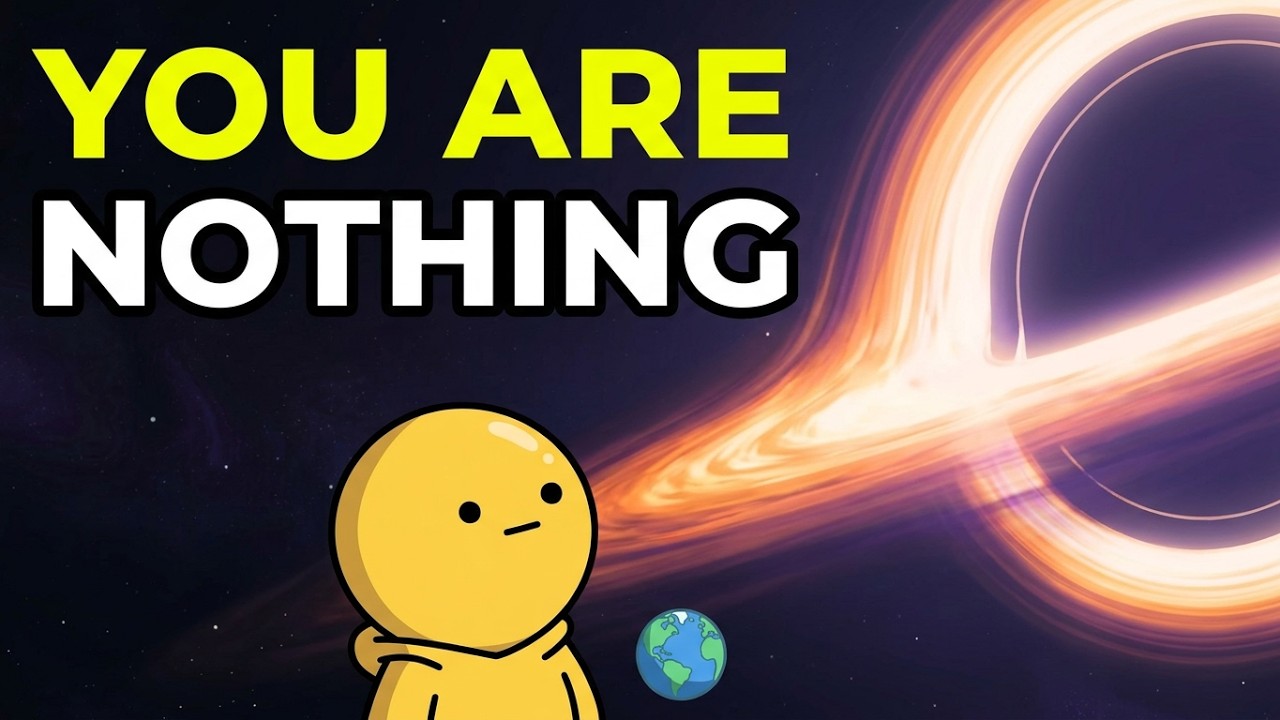
You think you understand how big space is. You don't. Nobody does.
Our brains evolved to understand distances like walking to the next village, not the space between galaxies.
So here are ten facts that will make you feel very, very small, starting close to home and ending at the edge of everything we can see.
Fact 1: The Sun Is Old News
When you look at the Sun, you're looking into the past.
Sunlight takes about eight minutes and twenty seconds to travel the 150 million kilometers to Earth.
And the same thing happens with every star you see at night. You're seeing light that left them years, centuries, even thousands of years ago.
So if the Sun suddenly vanished, you wouldn't know for eight whole minutes. The sky would look totally normal.
Fact 2: 1.3 Million Earths
The Sun is so big that about 1.3 million Earths could fit inside it.
Picture filling a giant bucket with marbles, then doing it again, over a million times.
The Sun alone holds more than 99 percent of all the mass in our solar system. Everything else, every planet, moon and asteroid, is basically leftovers.
And by star standards, our Sun is actually pretty average.
Fact 3: The Pale Blue Dot
In 1990, the Voyager 1 probe turned its camera back toward home from about six billion kilometers away.
In that photo, the entire Earth is a single pale blue dot, smaller than one pixel, floating in a beam of sunlight.
Astronomer Carl Sagan called it the pale blue dot, and said it was the only home we've ever known.
Every person, every city, every moment in history happened on that tiny speck.
Fact 4: Nearly 50 Years of Flying
Voyager 1 launched in 1977 and has been flying ever since, at about 17 kilometers every second.
It's the farthest human-made object ever. And in November 2026, it reaches one full light-day from Earth.
That means a message sent to Voyager at the speed of light takes a whole day to arrive.
At that speed you could cross the entire United States in about five minutes.
Nearly fifty years of nonstop flying, and it has barely left our neighborhood.
Fact 5: The Closest Star
The closest star to the Sun is Proxima Centauri, about 4.2 light-years away.
Sounds close, right? At Voyager's speed, getting there would take more than 70,000 years.
That's longer than all of recorded human history, many times over.
If the Sun were the size of a grapefruit in New York, Proxima Centauri would be another grapefruit thousands of kilometers away, roughly on the other side of the country.
And that's our nearest neighbor.
Fact 6: Billions of Suns
Our galaxy, the Milky Way, holds somewhere between 100 billion and 400 billion stars.
If you counted one star every second, nonstop, it would take you thousands of years to count them all.
And light itself, the fastest thing in the universe, needs about a hundred thousand years just to cross from one side of the Milky Way to the other.
And many of those stars have planets of their own.
Fact 7: More Stars Than Sand
Scientists estimate there are more stars in the universe than grains of sand on all of Earth's beaches.
And the Milky Way is just one galaxy. Astronomers think there are hundreds of billions, maybe even trillions, of galaxies out there.
Every beach, every desert, every grain. The stars still win.
Fact 8: The Heaviest Teaspoon
Some stars end their lives as neutron stars.
A neutron star can pack more mass than our entire Sun into a ball only about 20 kilometers wide, about the size of a city.
Some neutron stars spin hundreds of times every second, sweeping beams of radiation across space like a cosmic lighthouse.
It's so dense that a single teaspoon of it would weigh around a billion tons here on Earth.
Fact 9: A Grain of Sand
In 2022, the James Webb Space Telescope photographed a patch of sky about the size of a grain of sand held at arm's length.
In that tiny patch, it found thousands of galaxies.
Every one of those smudges of light is a whole galaxy, each with billions of stars of its own.
Now imagine doing that for every grain-sized patch across the entire sky.
Fact 10: The Edge of What We Can See
The part of the universe we can actually see is about 93 billion light-years across.
And because light takes time to travel, the farther we look, the further back in time we see.
Some of that light left its galaxy before Earth even existed.
Wait, if the universe is about 13.8 billion years old, how can it be 93 billion light-years across? Because space itself has been stretching the whole time, carrying galaxies apart.
And no one knows what lies beyond the edge of what we can see.
The Short Version
So yes, you are tiny. Almost unbelievably tiny.
But here's the strange part. You're also made of atoms forged inside ancient stars, a small piece of the universe that gets to look back at itself.
Which of these facts blew your mind the most?