Tesla's Car With No Steering Wheel Is Already Picking Up Passengers
Tesla's Cybercab has no steering wheel, no pedals and no mirrors, and people in Austin are already paying to ride in it.
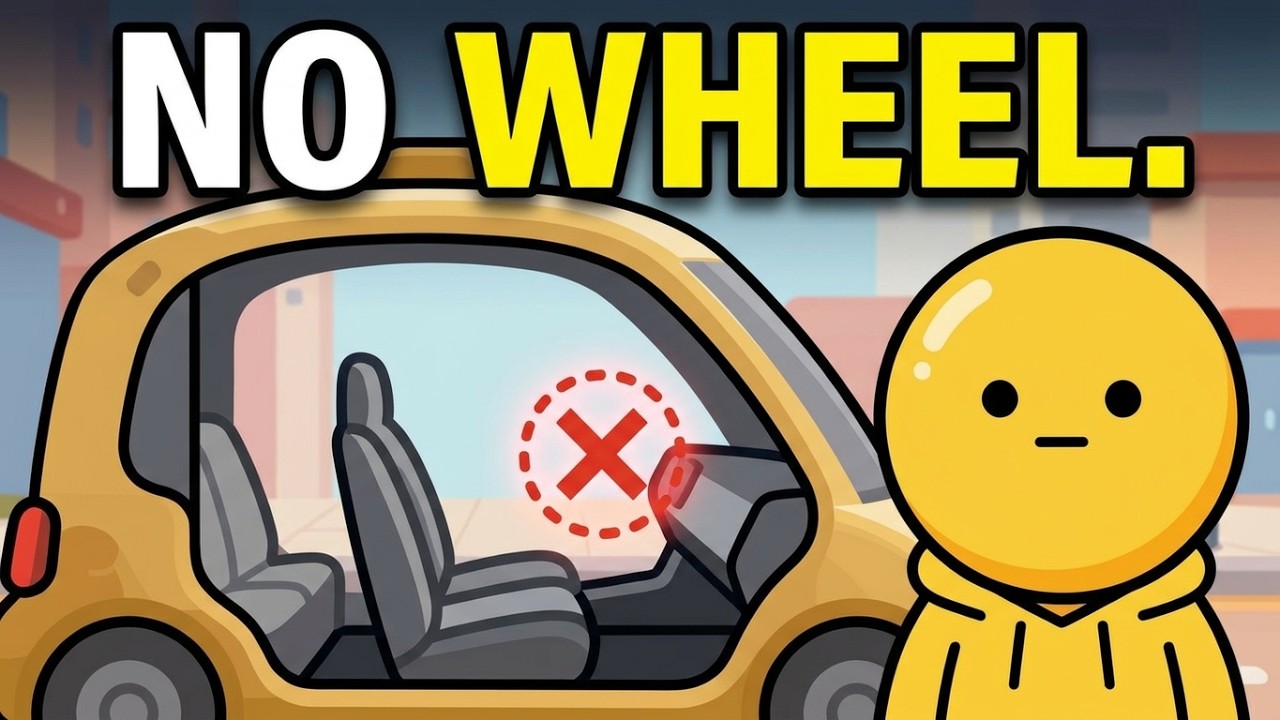
A small gold car pulls up to the curb. The doors swing up on their own. You climb in, and there's nobody driving. There isn't even a steering wheel.
This isn't a concept car anymore. In Austin, Texas, people are paying to ride in it right now.
It's Tesla's Cybercab. Here's what it is, how it drives itself, and the one big question nobody has answered yet. Stay to the end for that one.
No Wheel, No Pedals
First, the car itself. The Cybercab has two seats and two doors that open by themselves.
And it's missing things every car you've ever been in has. No steering wheel. No pedals. No side mirrors. Not even a rear window.
Tesla first showed it off in October 2024, at an event on a Hollywood studio lot, where twenty of them drove guests around at night.
Real production started this year at Tesla's factory in Texas. The first one came off the line in February, and full production began in April.
How It Drives Itself
So who's driving? Software. The car runs Tesla's Full Self-Driving system, the unsupervised version, with no human backup inside.
And it sees the world using cameras. Only cameras.
That's a big bet. Waymo, the biggest robotaxi company, also uses lidar and radar, sensors that bounce lasers and radio waves off everything around the car.
Tesla's argument is simple. Humans drive with just their eyes, so a car should be able to as well. Critics say extra sensors are a safety net you don't want to skip.
The Specs
Under the floor is a battery of about 48 kilowatt-hours. That's small for an electric car, but this one is light and slippery.
Preliminary EPA figures put its range at about 293 miles on a charge.
Tesla says it has about half the parts of a Model 3, and it's designed to last five hundred thousand miles.
And here's a weird detail. It can only use fast chargers. You can't plug it in at home, because it was never meant to be parked in your garage. It's built to work all day as a taxi.
Where You Can Ride It
Right now, the only place to ride one is Austin, Texas.
Tesla has run a robotaxi service there since June 2025, using self-driving Model Ys. On September 4th, 2026, the Cybercab joined that service with paid rides.
Because it only has two seats, bigger groups still get a Model Y.
As of October 10th, Tesla had registered 319 Cybercabs in Texas. It's also touring cities in Asia, but only as a show. No rides there yet.
Why It's So Cheap
So why build a car like this at all? Cost.
Without a driver to pay, the biggest cost of a taxi disappears. Tesla's goal is to run the Cybercab for under thirty cents a mile.
For comparison, Waymo's earlier self-driving cars cost over one hundred thousand dollars each to build, loaded with expensive sensors.
If Tesla pulls it off, rides could get much cheaper. That's a big if, and it's still a goal, not a proven number.
The Big Question
Now, the question I promised. Is a car with no steering wheel even allowed?
America's federal safety rules were written for cars with human drivers. They expect things like steering wheels, pedals and mirrors.
Carmakers certify their own vehicles. Tesla says the Cybercab meets the rules. But on September 4th, the same day paid rides started, the federal safety regulator, NHTSA, opened an investigation into that certification.
A Texas fire department has also raised concerns. Without a steering wheel, some emergency procedures firefighters use on crashed cars don't work the same way.
Regulators are now drafting new rules for driverless cars. Until those exist, the Cybercab is driving in a gray area.
Real or Hype?
So, is the Cybercab real? Yes. It's built in a factory and people are paying to ride it in Austin today.
Is it ready to replace your car everywhere? Not yet. It's in one city, under a federal investigation, waiting on rules that don't exist yet.
Would you take a ride?


